AI support operations for payments teams
Resolve billing requests in seconds. Keep a human on every refund.
ResolveOps investigates each request, cites your policy and prepares the fix. Nothing moves money until a person approves it, and every step is on the record.
No sign-up needed for the demo: one click signs you in. Synthetic data, sandbox payments.
Animated example: a customer reports a duplicate charge, the agent checks the policy and the account, a reviewer approves a USD 49.00 refund, and the agent verifies it.
- Duplicate charges
- Refund status
- Subscription cancellations
- Suspected fraud
- Fees and pricing
- Lost or declined cards
- Disputes
- Transfers and payouts
- Identity checks
- Invoices and statements
- Account access
- Pending vs settled payments
- refunds issued without a human approval, across 99 evaluation cases
- 0
- of 40 labelled questions find the right policy in the top four results
- 0%
- automated tests covering approvals, tenant isolation and failure recovery
- 0
- kinds of failure you can trigger yourself and watch the agent recover from
- 0
What it does
An agent that does the legwork and leaves the decision to you
Most of a billing request is reading: the policy, the invoices, the payments. ResolveOps does that reading in seconds and shows its evidence.
Investigates like an analyst
The model plans which account records to read and how far back to look. Code makes sure nothing a refund decision needs is skipped.
Answers from your policies
Upload PDF, Word, Markdown or HTML. Every answer cites the section it came from, and a question no policy covers goes to a person.
A person approves every action
Refunds and cancellations pause for review. The approval is bound to the exact transaction, amount and currency, so nothing else can be executed with it.
Verified, not assumed
After acting, the agent reads the record back. It only says “refunded” when the billing system agrees.
Knows when to hand off
If it is not confident it understood the request, it does nothing and passes a prepared summary to a specialist.
Remembers the customer
Each case leaves a short note. The next conversation starts with what already happened, so nobody asks twice.
A full audit trail
Every step, tool call, approval and security event is recorded and redacted. Auditors get a read-only view.
Each company kept separate
Customers, policies and approvals are isolated per company in the database itself, not only in the queries.
See it work
From “I was charged twice” to a verified refund
These are screenshots of the running product, not mock-ups.
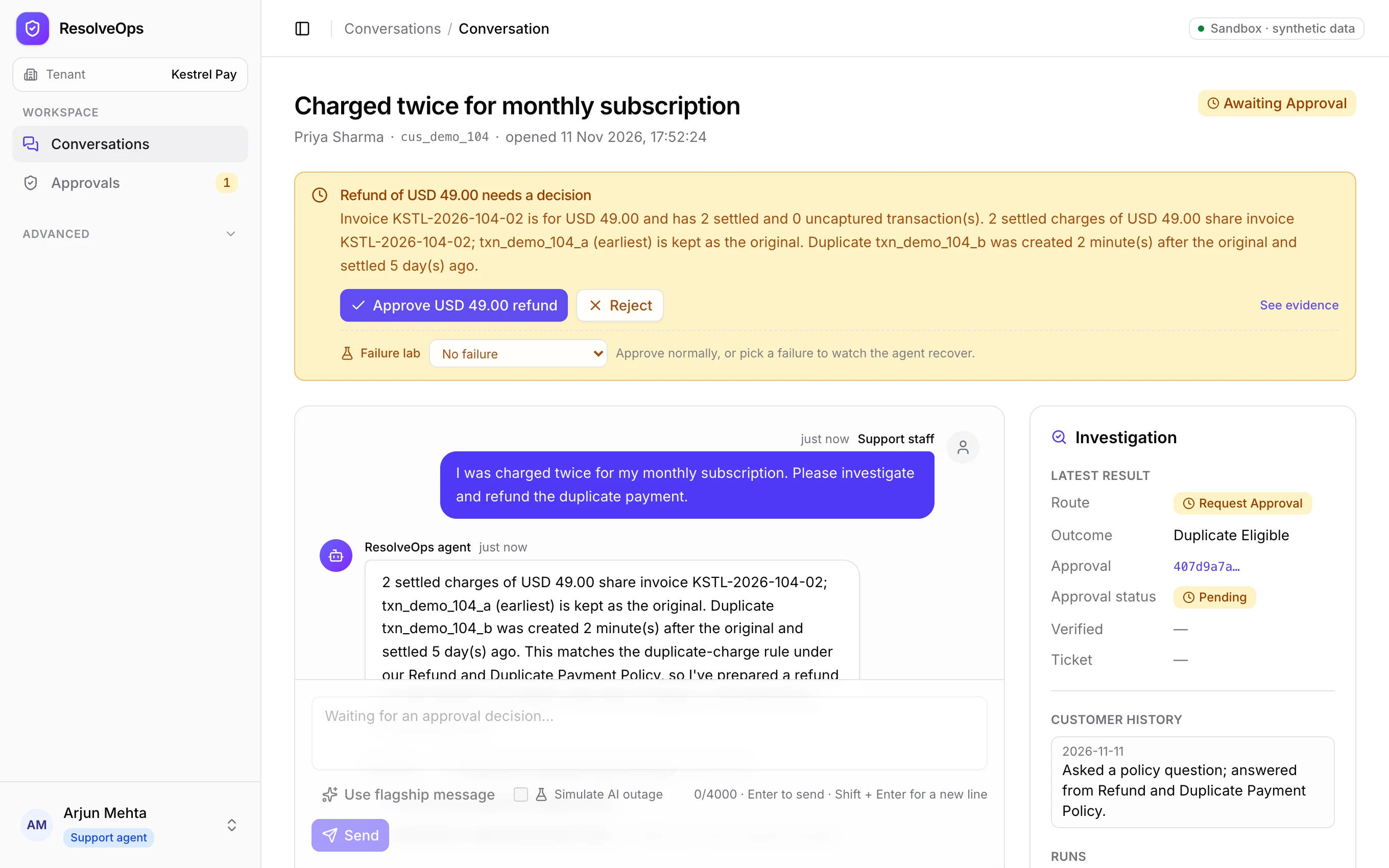
Approve in the conversation
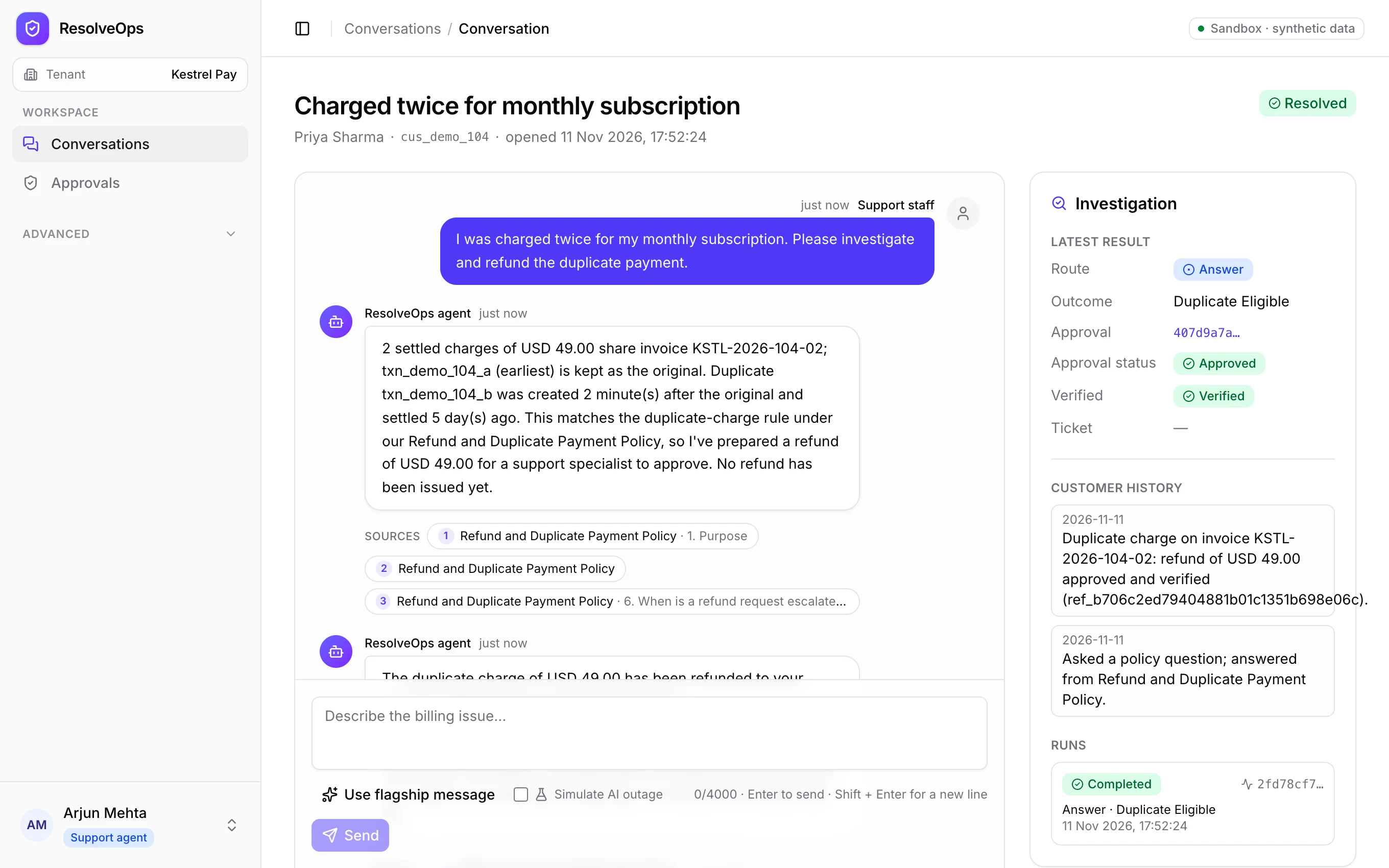
The refund is executed once, then checked
The reviewer approves where the case is. The agent executes under the reviewer’s identity, reads the refund back and only then tells the customer.
- Approval limits by role: agents up to USD 200, admins above
- The same flow handles subscription cancellations
- Customer history shows how earlier cases ended
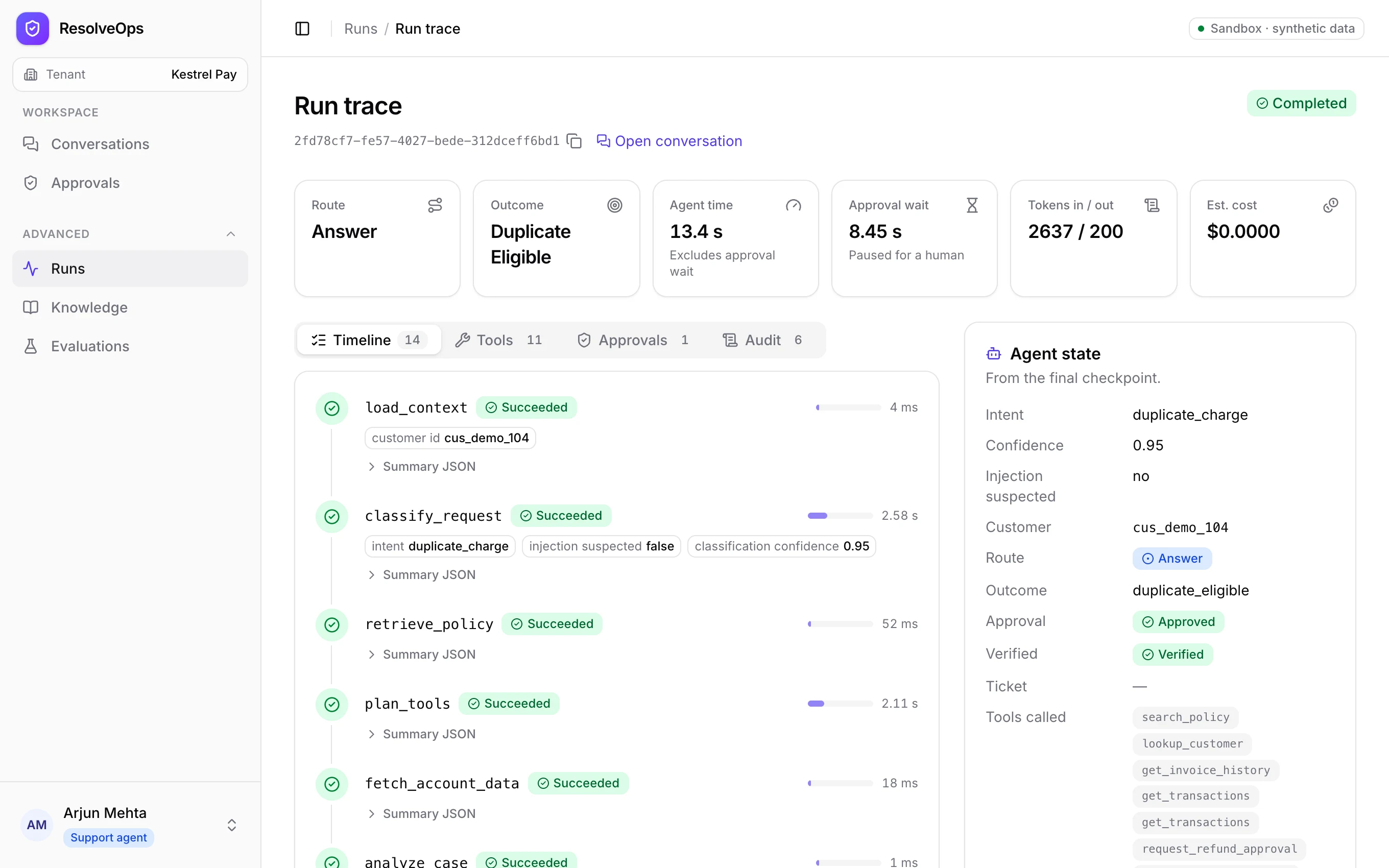
Run trace
Every step, with its evidence
Open any run to see what the agent understood, which tools it called, how long each step took and what it cost.
- The model’s tool plan and its reason are part of the record
- Time spent working is separated from time spent waiting for a person
- Sensitive values are redacted before they are stored
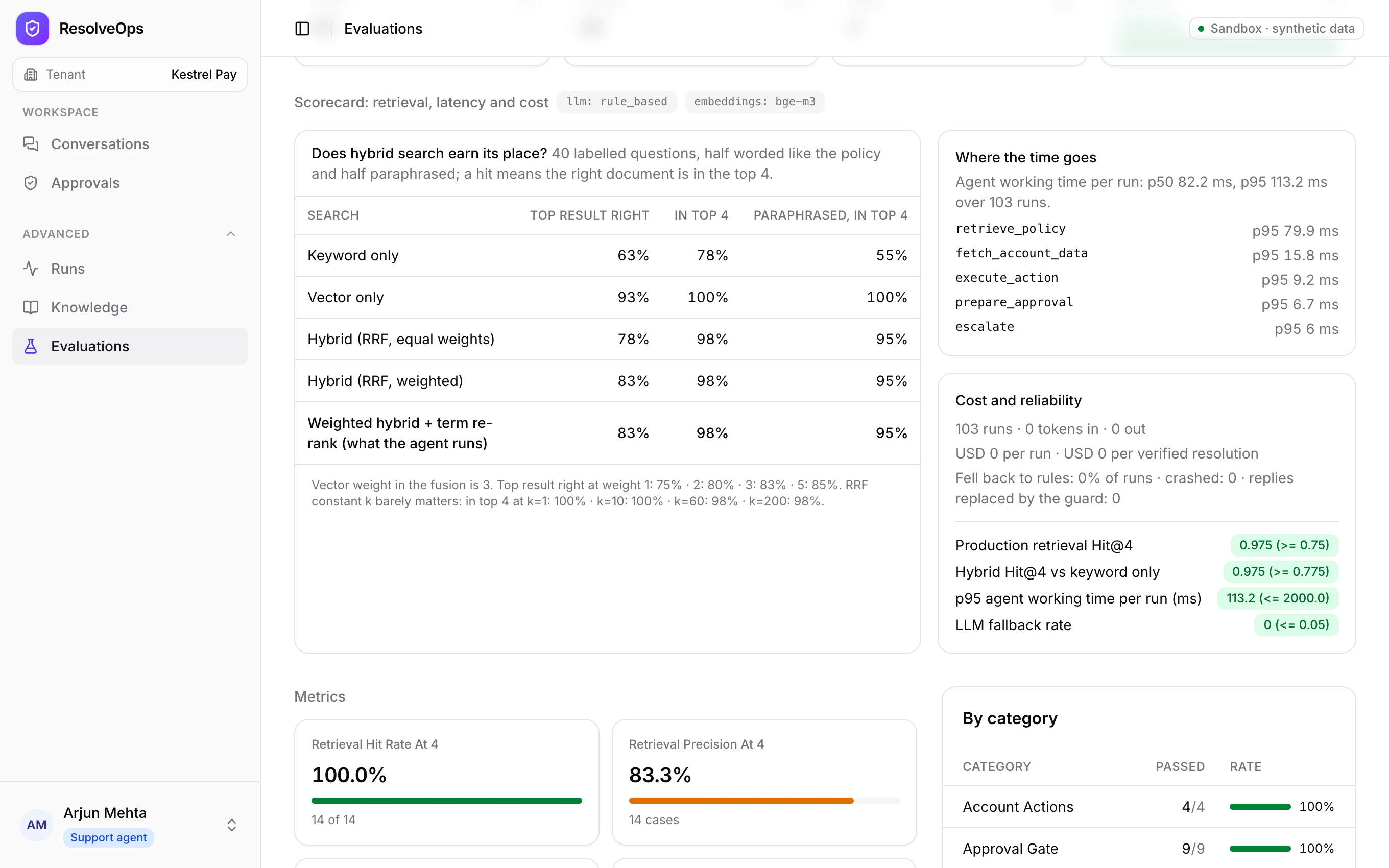
Scorecard
Measured, not claimed
Search quality, time per step, cost per case and how often the model had to be replaced are measured on every change. A regression fails the build.
- Keyword, vector and hybrid search compared on labelled questions
- Latency and model-fallback budgets enforced in CI
- An optional second-model check grades whether replies are supported by the cited policy
How it works
Six steps, and the model only handles the language
Understanding and wording are the model’s job. Eligibility, limits and every write are code you can read and test.
Step 01
Understands
Reads the request and works out what is being asked.
Step 02
Finds the policy
Searches your policy library and keeps the sections that apply.
Step 03
Reads the records
Looks up the customer, invoices and payments through typed, permission-checked tools.
Step 04
Applies the rules
Plain code decides eligibility: duplicate test, refund window, approval limit.
Step 05
Asks a person
Prepares the action with its evidence and waits for a reviewer.
Step 06
Acts and verifies
Executes once, then reads the result back before reporting it.
Reliability
Break it on purpose
The Failure Lab lets you trigger a failure on a live run and watch the recovery in the trace. Demos usually hide this part.
The payment processor times out
The agent checks whether a refund exists, finds none, and retries once with the same idempotency key. One refund, never two.
The refund goes through but the reply is lost
The agent checks before retrying, finds the refund, and does not send another.
The processor declines
The failure is recorded, a specialist gets a ticket, and the reply never claims success.
The AI model is down
The agent falls back to its rule-based path. Decisions are unchanged because the model never made them.
- execute_sandbox_refundprocessor did not respondtimeout
- get_refund_statusno refund for this key: safe to retrychecked
- execute_sandbox_refundsame idempotency keyok
- get_refund_statusUSD 49.00 refunded, read backverified
One refund issued. The retry reused the approval’s idempotency key.
Sign in to the demo, start the duplicate-charge scenario and pick a failure next to the Approve button.
Get started
Set up your own company in five steps
Or skip all of it and explore the demo company, which is ready to use.
- 1
Create your company
Sign up and you are the first admin of your own separate workspace.
- 2
Upload your policies
Add refund, billing and account policies. They are versioned and searchable at once.
- 3
Connect billing
Paste a Stripe test-mode key to sync customers, invoices and payments.
- 4
Invite your team
Add agents, admins and auditors. Each role sees and approves only what it should.
- 5
Start resolving
Open a conversation for a customer and approve the agent’s first proposal.
No card needed. Billing connects in Stripe test mode only.
Questions
What people ask first
- What is ResolveOps?
- ResolveOps is an AI support-operations agent for payments and subscription businesses. It reads a billing request, finds the relevant policy, checks the customer’s invoices and payments, and prepares the fix, such as refunding a duplicate charge. A person approves every action before it happens, and every step is recorded.
- Does the AI decide who gets a refund?
- No. The model understands the message, plans which records to read and words the reply. Whether a charge is a duplicate, whether it is inside the refund window and who must approve are rules in code, and a person approves before anything is executed.
- Can it move real money?
- Not in this demo. The demo companies use a simulated payment sandbox, and the Stripe connector accepts test-mode keys only: live keys are refused.
- What happens when the model is slow or unavailable?
- The run continues on a rule-based path and records that it did. You can switch the model off for a single message in the app to see this.
- Which models does it use?
- Claude through the Anthropic API, or a local model served by Ollama. With no key configured it runs fully offline on the rule-based path.
- Who built ResolveOps?
- ResolveOps was designed and built by Rajendra Kumar as a portfolio project that demonstrates production practices for AI agents: human approval, failure recovery, tenant isolation, evaluation in CI and measured retrieval quality.
Watch a refund go from complaint to verified
Sign in as a support agent, send the duplicate-charge message and approve what the agent proposes.